
Study Review: Menstrual Cycle and Strength Performance
Authored by: Dr Hazel Wallace with contribution from Kelly McNulty
Many of you will have seen this paper floating around social media, and I know this because many of you have sent me posts of people interpreting it and asking me to share my opinion on it.
The paper in question is titled “Current evidence shows no influence of women's menstrual cycle phase on acute strength performance or adaptations to resistance exercise training” (1) which many people found surprising to hear and even triggering.
This is not the first paper to come to this conclusion, and I’m sure not the last, as the research in this space is sparse, often poorly designed and conflicting with some studies finding a difference in strength performance and strength adaptation between different menstrual cycle phases and others reporting no difference - or inconclusive findings. This paper was only just published in 2023 and the research was analysed in January 2022, so in theory it is the most up-to-date review of the current research available.
So let’s take a look at what they found.
Study overview
The aim of the study was to understand “how the menstrual cycle phase might affect exercise performance and gains in muscle size and strength” (1).
What we know on this topic so far is largely conflicting, as discussed, and furthermore it’s become quite popular in research, and in practice, to promote menstrual cycle phased-based training (i.e. structuring your training around your menstrual cycle), with some suggestion that the late follicular phase may be a good time to hit strength PB’s, and so the authors wanted to decipher if this was truly an evidence-based practice.
So they conducted an umbrella review of meta-analyses and systematic reviews. This type of research is basically an overview of previous reviews on this topic in order to provide an overall assessment of the current available evidence. In terms of the hierarchy of evidence, it is considered the highest available there is (i.e. it’s great quality!) but it’s not primary research (i.e. they’re not carrying out the research themselves but conducting an analysis of existing data to determine its usefulness).
To do this, they collated all the available literature that met the following criteria: “English-language systematic reviews and meta-analyses of menstrual cycle phase-based resistance exercise training outcomes in young, healthy eumenorrheic women with no known menstrual cycle dysfunctions who were not using hormonal contraceptives” (1).
In other words, they pooled together large reviews of several studies, related to the menstrual cycle and resistance training (in terms of performance and strength adaptations), that already exist. For clarity, resistance training relates to training that increases muscle strength by making your muscles work against a weight or force for example, lifting weights or using your body weight to do squats and push-ups. They excluded people on hormonal contraception and those with irregular periods.
Results
12 papers were found, 5 of which were deemed suitable to be included in the review. They assessed the quality of each review using critical appraisal and standardised grading tools. I’ve adapted the table below from the original paper to show the main findings of the original study, and the outcome generated in terms of sufficiency of evidence following the review.
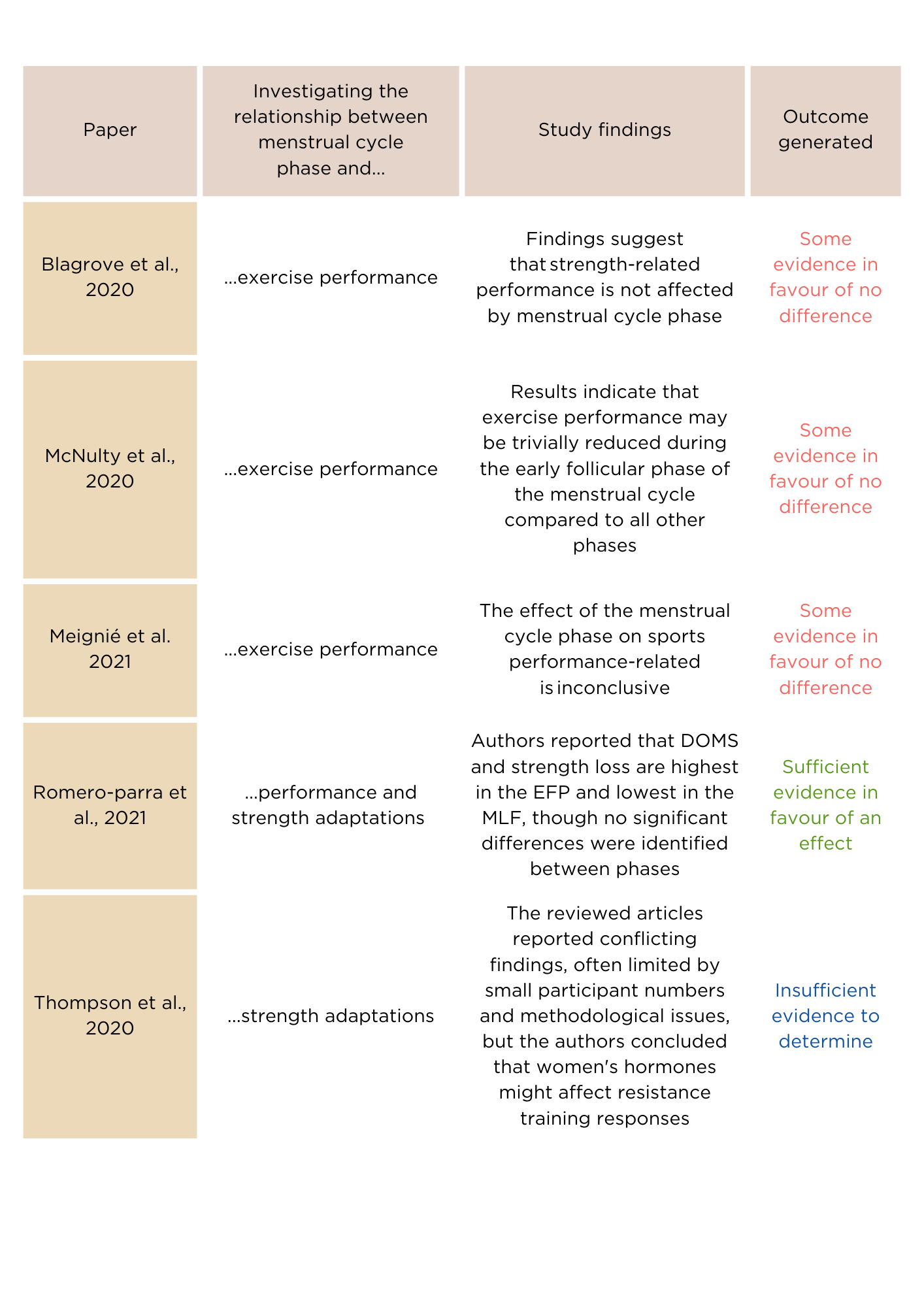
ELF : early follicular phase, MLF: mid-luteal phase, adapted from Colenso-Semple et al., 2023.
Conclusion
The authors concluded that the current evidence we have on differences between menstrual cycle phases in strength and performance, and muscle growth, is mostly low-quality and inconsistent. However,, there is some weak evidence to suggest the menstrual cycle phase can influence DOMS (Delayed Onset Muscle Soreness).
Important considerations
When conducting research on menstruating individuals, we make the assumption that everyone has the same textbook menstrual cycle with ovulation happening mid-way through the cycle on day 14, and the follicular and luteal phases falling either side for 14 and 13 days, respectively. The authors make a very good point however - this is what we may expect, but it’s not reality and when we look at “real world” averages, we see:
Follicular phaseon : 18.5 days in length on average (7)
Luteal phase: 12 days in length on average (7)
Ovulation: typically day 14-16 but can vary by 10 days (8)
So there is huge variation between people and between cycles. Therefore without measuring sex hormone concentrations (which most of this research fails to achieve), it leaves research around the menstrual cycle largely up to guess work and algorithms - meaning there is potential for huge inaccuracies.
Therefore, making generalised recommendations or training programmes around the menstrual cycle is just impractical.
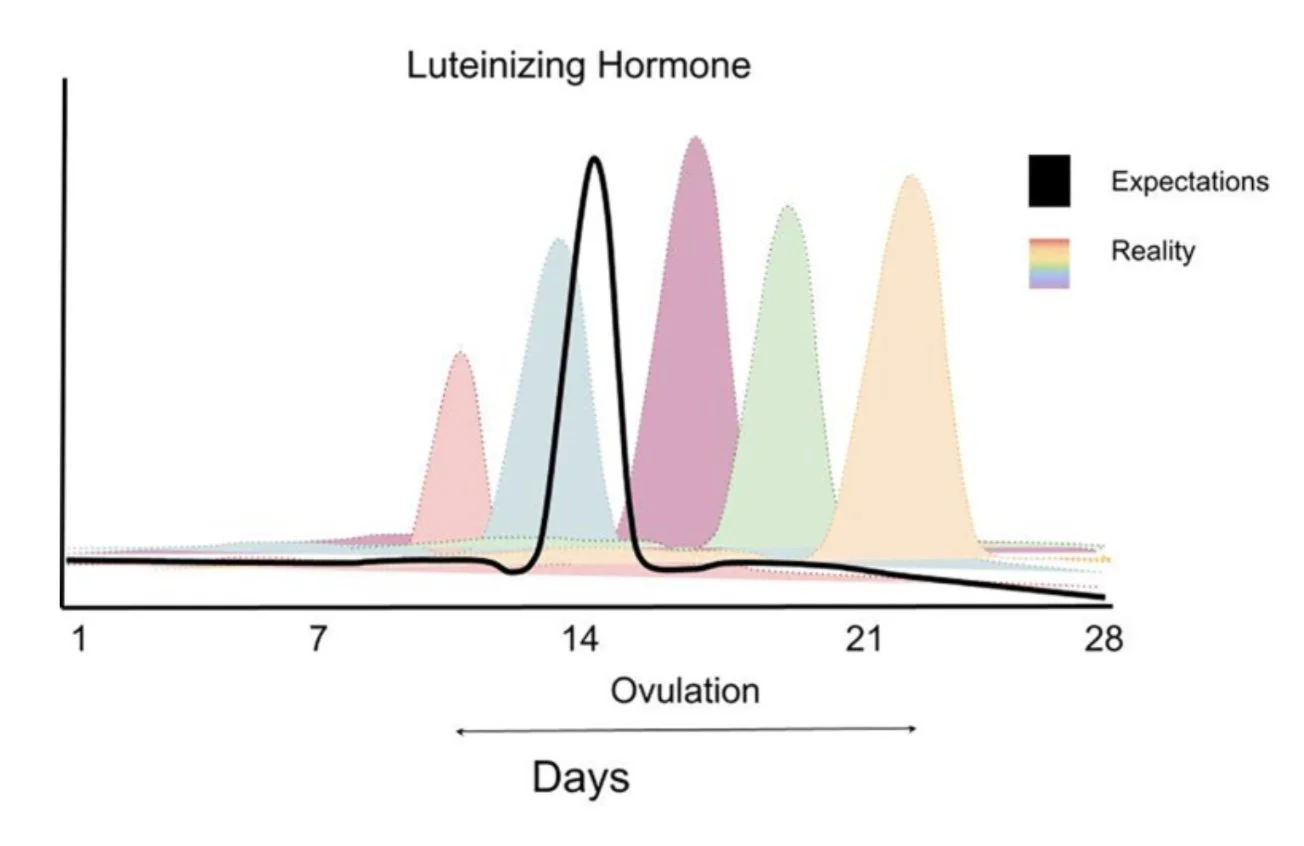
Source: Colenso-Semple et al., 2023.
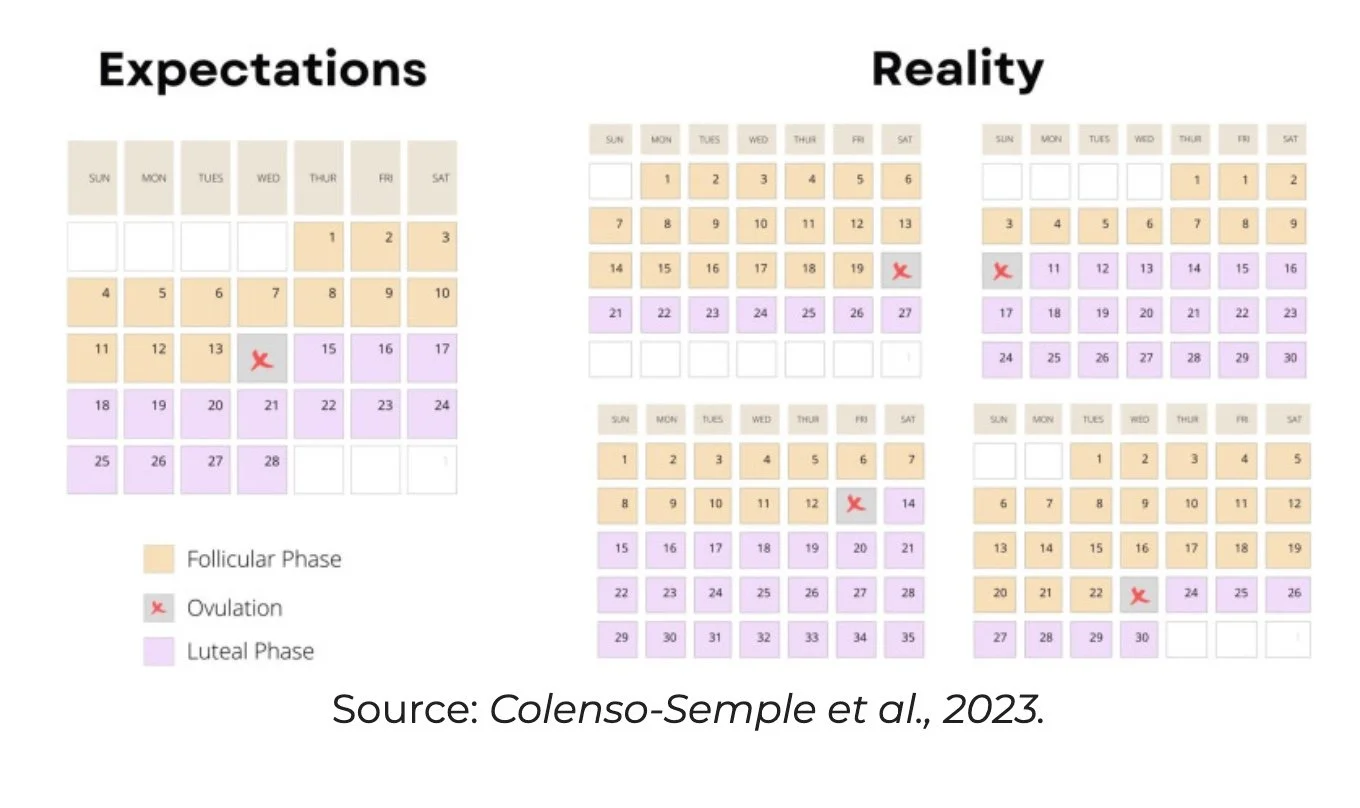
Source: Colenso-Semple et al., 2023.
Some studies do attempt to overcome this by using less-invasive and cost-effective methods such as:
Urinary ovulation predictor tests: these work by identifying the surge in luteinising hormone (LH) that triggers ovulation and are actually pretty accurate (97%) (9). Obviously testing body fluids can be quite expensive, time-consuming and sometimes invasive for the study participants so it is very rarely done.
Basal body temperature: We can also use Basal body temperature (BBT) which increases by ~ 0.3 C (0.5-1 F) in luteal phase & remains elevated until menstruation. This is an indication that ovulation has occurred but its accuracy is roughly 22% because BBT is influenced by many factors (illness, alcohol, stress - even wake time) (9). Checking changes to cervical mucus is actually a more accurate method of determining ovulation.
Calendar-based methods: When using calendar-based methods,’ we should really be looking at 3-6 month averages, even before study enrolment, to better understand what someones “normal” is. It’s important to point out that even if menstruation (the period) occurs, that does not guarantee ovulation has occurred.
Author recommendations
In sum, the available reviews and meta-analyses suggest that menstrual cycle phase has a limited effect on strength performance and emphasises the influence of low-quality studies with poor methodological quality on which to base firm conclusions.
The authors recommend that right now;
Programmes should be tailored to the individual, not based on the menstrual cycle phase until we have higher-quality evidence
Menstrual cycle should be considered as a potential influencing factor (alongside sleep, stress, nutrition etc) when designing a resistance training programme
This to me is largely positive and sets us free from this narrative of our sex hormones dictating BUT what none of these reviews have considered is the perceived effect and symptoms and I think this is KEY = yes our sex hormones might not be influencing our performance directly BUT they might be having indirect effects that might influence our performance.
My takeaway
If you’ve read my book The Female Factor or have followed my work for the last few years, you will know by now that I am incredibly passionate about understanding how the menstrual cycle influences our strength, energy, and performance and how we can use this information to influence our training and recovery. However, my overarching message remains the same, the recommendations from the limited research we have may guide us, but shouldn’t be seen as the rule and the most important piece of evidence comes from collecting data from your own menstrual cycle and understanding how that affects your training and recovery.
Is this a bad thing? No, it can be largely positive and sets us free from this narrative of our sex hormones dictating how strong we are or how well we perform BUT what none of these reviews have considered is the perceived effect and how menstrual symptoms affect us, which I think this is KEY. Yes our sex hormones might not be influencing our performance directly BUT they might be having indirect effects that might influence our performance.
As someone who menstruates, I find this practice incredibly empowering and helpful to guide my training - and lifestyle in general. However, no two people are the same - no two cycles are the same - and not everyone will experience significant changes in strength performance across their cycle and/or improved strength adaptation with phase-based training.
But that does not mean that differences do not exist, and the absence of (good quality) evidence is not evidence of absence.
So I echo what those authors conclude and I call for more evidence and I also urge you not to disregard the menstrual cycle as a potential influencing factor (alongside sleep, stress, nutrition, etc.) when it comes to how we perform inside and outside of the gym.
References
Colenso-Semple LM, D'Souza AC, Elliott-Sale KJ, Phillips SM. Current evidence shows no influence of women's menstrual cycle phase on acute strength performance or adaptations to resistance exercise training. Front Sports Act Living. 2023 Mar 23;5:1054542. doi: 10.3389/fspor.2023.1054542. PMID: 37033884; PMCID: PMC10076834.
Blagrove RC, Bruinvels G, Pedlar CR. Variations in strength-related measures during the menstrual cycle in eumenorrheic women: a systematic review and metaanalysis. J Sci Med Sport. (2020) 23(12):1220–7. doi: 10.1016/j.jsams.2020.04.022
McNulty KL, Elliott-Sale KJ, Dolan E, Swinton PA, Ansdell P, Goodall S, et al. The effects of menstrual cycle phase on exercise performance in eumenorrheic women: a systematic review and meta-analysis. Sports Med. (2020) 50(10):1813–27. doi: 10.1007/s40279-020-01319-3
Meignié A, Duclos M, Carling C, Orhant E, Provost P, Toussaint JF, et al. The effects of menstrual cycle phase on elite athlete performance: a critical and systematic review. Front Physiol. (2021) 12:654–585. doi: 10.3389/fphys.2021.654585
Romero-Parra N, Cupeiro R, Alfaro-Magallanes VM, Rael B, Rubio-Arias JÁ, Peinado AB, et al. Exercise-Induced muscle damage during the menstrual cycle: a systematic review and meta-analysis. J Strength Cond Res. (2021) 35(2):549–61. doi: 10.1519/JSC.0000000000003878
Thompson B, Almarjawi A, Sculley D, Janse de Jonge X. The effect of the menstrual cycle and oral contraceptives on acute responses and chronic adaptations to resistance training: a systematic review of the literature. Sports Med. (2020) 50 (1):171–85. doi: 10.1007/s40279-019-01219-1
Najmabadi S, Schliep KC, Simonsen SE, Porucznik CA, Egger MJ, Stanford JB. Menstrual bleeding, cycle length, and follicular and luteal phase lengths in women without known subfertility: A pooled analysis of three cohorts. Paediatr Perinat Epidemiol. 2020 May;34(3):318-327. doi: 10.1111/ppe.12644. Epub 2020 Feb 27. PMID: 32104920; PMCID: PMC8495765.
Soumpasis I, Grace B, Johnson S. Real-life insights on menstrual cycles and ovulation using big data. Hum Reprod Open. 2020 Apr 16;2020(2):hoaa011. doi: 10.1093/hropen/hoaa011. PMID: 32328534; PMCID: PMC7164578.
Su HW, Yi YC, Wei TY, Chang TC, Cheng CM. Detection of ovulation, a review of currently available methods. Bioeng Transl Med. 2017 May 16;2(3):238-246. doi: 10.1002/btm2.10058. PMID: 29313033; PMCID: PMC5689497
Join the Membership
Join the Membership

Join The Food Medic hub on a monthly or annual membership and have full access to all our articles and recipes.